

A Lifestyle Spending Account (LSA) is an employer-funded benefit that gives employees money to spend on eligible expenses the employer defines. An Emergency Savings Account (ESA) is a benefit that helps employees set aside their own money over time so they have a cushion for unexpected expenses. The simplest way to remember the difference is that an LSA is designed to spend, and an ESA is designed to save.
Both benefits can play a valuable role in an employee financial wellness strategy, but they solve different problems. This guide explains how each one works, where they differ, and how HR and benefits leaders can decide which fits their workforce.
The need for savings is widespread. The Federal Reserve’s 2025 Economic Well-Being of U.S. Households survey found that 37% of adults would not cover a $400 emergency expense entirely with cash or its equivalent. For many employees, the gap between a lifestyle perk and a financial cushion is the difference between absorbing a surprise bill and turning to credit.
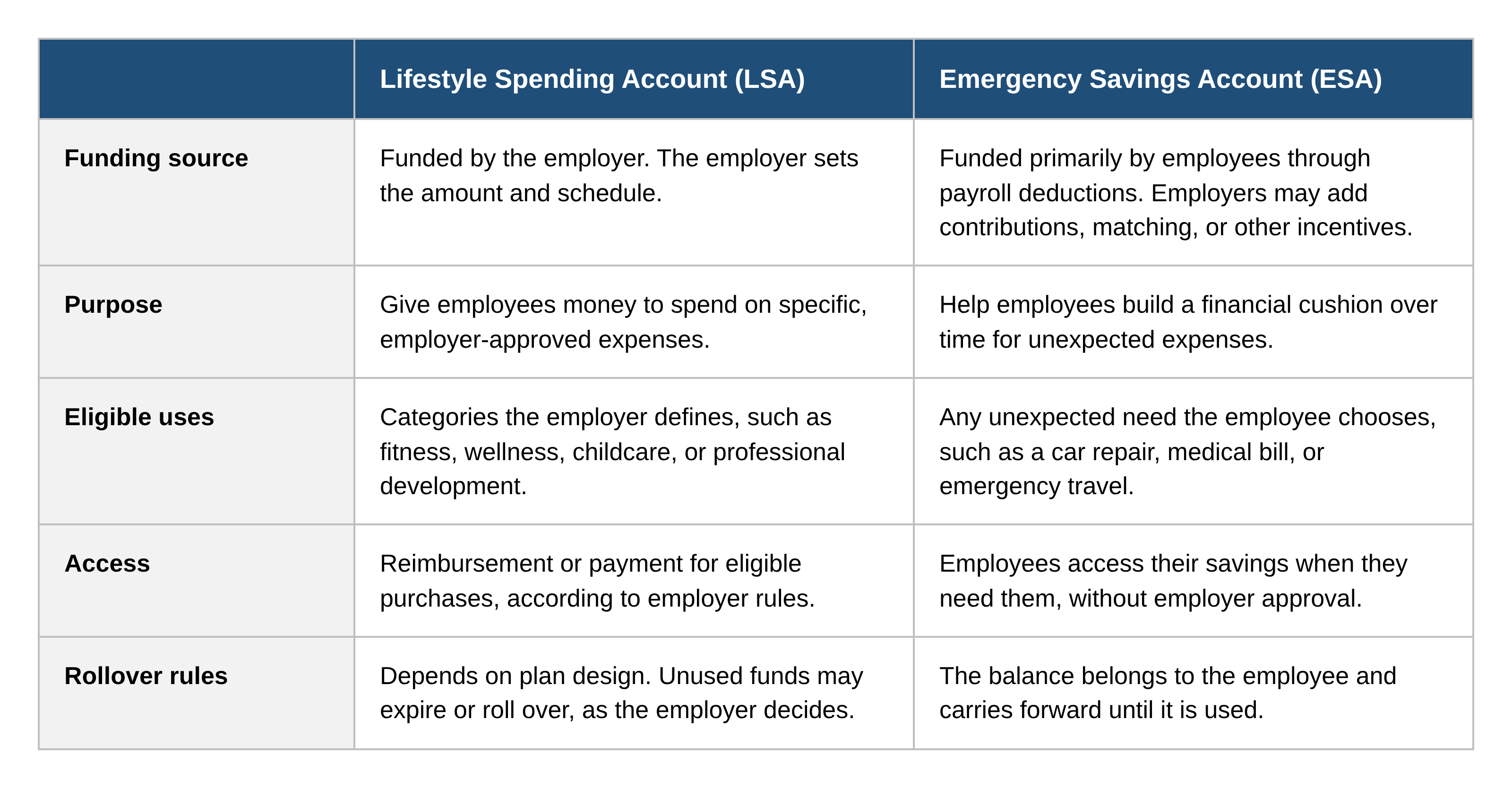
LSA and ESA at a Glance
Here is how the two benefits compare across the areas that matter most to benefits teams. The ESA column reflects the type of emergency savings solution Sunny Day Fund offers. Features of other emergency savings programs may vary.
What Is a Lifestyle Spending Account?
A Lifestyle Spending Account is an employer-funded spending benefit. Employers provide a set amount of money that employees can use toward eligible expenses, and the employer defines the categories, funding amount, and rules for use. Funding arrangements and rollover rules depend on how the employer designs the plan.
Think of an LSA as an employer-funded allowance for specific purchases, such as a gym membership, fitness equipment, childcare, or a professional development course.
What Is an Emergency Savings Account?
An Emergency Savings Account is designed to help employees build a financial cushion for expenses they cannot predict. Employees typically contribute their own money through payroll deductions and build a balance gradually. Employers can encourage participation through contributions, matching funds, or other incentives.
The balance belongs to the employee, who decides when and how to use it. Think of an ESA as a financial cushion employees build before they need it.
The Key Difference: Spending vs. Saving
An LSA gives employees money to spend on specific things. An ESA helps employees build money they can save for unexpected things.
That distinction matters in practice. An employee might use an LSA to pay for a gym membership, fitness equipment, childcare, or professional development. Those are planned expenses that fall within the employer’s defined categories.
An employee might use emergency savings to pay for an unexpected car repair, a medical expense, emergency travel, or another financial surprise. Those are unplanned expenses the employee could not have budgeted for in advance.
One benefit is organized around what employees are allowed to spend money on. The other is organized around making sure employees have money available when they do not know what expense is coming next.
Why an LSA Is Not an Emergency Savings Account
It is easy to see why these benefits sometimes get grouped together. Both provide financial support outside of traditional compensation, and both can improve how employees feel about their employer. Calling an LSA a savings solution, however, can create the wrong expectations.
The clearest distinction is that an LSA provides employer-defined eligible spending, while an ESA holds savings that employees accumulate and access as needed. LSA funds are intended for the specific expenses the employer has approved, and whether unused funds carry forward depends on the plan design. Emergency savings work differently. The objective is to accumulate a balance over time so that employees have their own resources available when an unexpected expense occurs.
Can Both Fit in a Benefits Strategy?
Yes. This is not necessarily a question of choosing one benefit over the other.
LSAs can be a valuable way for employers to support employee wellness, lifestyle, and other specific needs through employer-funded dollars. Emergency savings address a different challenge by helping employees build the financial resilience to handle unexpected expenses without immediately turning to credit cards, loans, or retirement plan withdrawals.
For HR and benefits leaders, the important thing is to understand which problem each benefit is designed to solve. If the goal is to give employees additional dollars for specific lifestyle or wellness expenses, an LSA may be the right tool. If the goal is to help employees build a financial cushion for life’s unexpected expenses, an emergency savings solution may be the better fit.
If you are not sure which is right for your people, follow the data. Review aggregate hardship withdrawal trends in your retirement plan and listen to employee feedback through surveys or benefits conversations. Frequent hardship withdrawals or requests for short-term financial help are signals that employees would benefit from a way to build resilience over time. Emergency savings are most effective when they are built steadily, before a crisis arrives, so that an unexpected expense becomes a manageable event rather than a setback.
Frequently Asked Questions
Is a Lifestyle Spending Account the same as an Emergency Savings Account?
No. An LSA is employer-funded money for eligible expenses the employer defines. An ESA holds savings that employees accumulate and can access for any unexpected need.
Who funds an LSA and who funds an ESA?
Employers fund LSAs. ESAs are funded primarily by employees through payroll deductions, and employers may add contributions, matching, or incentives to encourage participation.
Can employees use LSA funds for emergencies?
Generally only if the expense falls within the categories the employer has approved. LSAs are built for planned, eligible purchases rather than unplanned financial needs.
Should an employer offer an LSA or an ESA?
It depends on the problem the employer wants to solve. LSAs support lifestyle and wellness spending. ESAs help employees build financial resilience. Many employers offer both.
Build Emergency Savings Alongside the Benefits You Already Offer
Learn how Sunny Day Fund can help your employees build emergency savings alongside the benefits you already offer. Visit sunnydayfund.com or contact our team to see how an emergency savings benefit fits into your financial wellness strategy.